US dividend withholding tax in a TFSA, RRSP or taxable account (Canada)
Updated October 26, 2026
When a US company pays a dividend to a Canadian resident, the US keeps part of it before it reaches you. Under the Canada–US tax treaty that's usually 15 %, as long as your broker has your W-8BEN form; without it, 30 %. Whether you get that 15 % back depends on the account.
Account by account (US-listed stocks and ETFs)
- RRSP, RRIF and other retirement accounts: the treaty treats them as pension accounts, so US dividends are generally paid in full — no withholding.
- TFSA, FHSA and RESP: not covered by the treaty exemption. The 15 % is withheld and can't be recovered.
- Non-registered (taxable): the 15 % is withheld, and you can usually claim it as a foreign tax credit against the Canadian tax on that income — so it isn't lost, it's prepaid.
Canadian-listed ETFs that hold US stocks
If a Canadian-listed ETF owns US stocks directly, the 15 % is withheld before the fund receives the dividends. It doesn't appear on your statements and can't be recovered in any account, RRSP included. A US-listed ETF held in an RRSP avoids it.
Canadian dividends
Dividends from Canadian companies carry no withholding for Canadian residents. In a non-registered account, eligible Canadian dividends get the dividend tax credit.
US investors holding Canadian stocks
The treaty works the other way too: Canada generally withholds 15 % on dividends paid to US residents. In a taxable account it's usually creditable on your US return; retirement accounts can be exempt with the right forms on file at your broker.
How Income Viz handles it
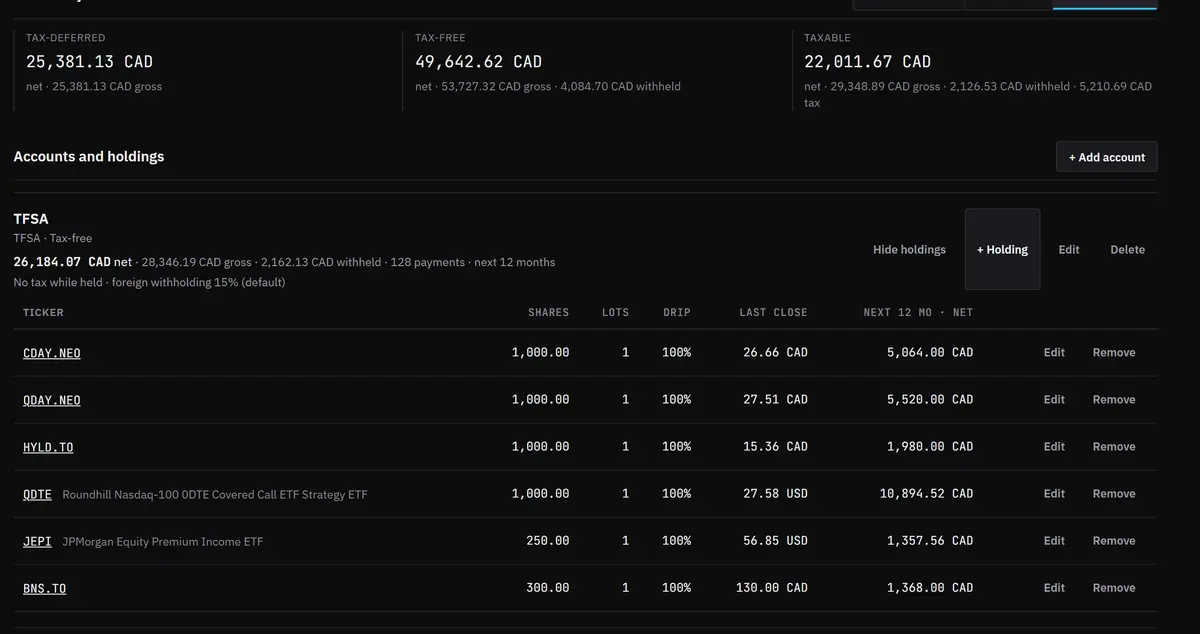
Each account has a type — TFSA, RRSP / RRIF, FHSA or non-registered in Canada; taxable, traditional, Roth or HSA in the US — with the usual withholding and tax rules as defaults, which you can override per account. Every payment is shown gross, after withholding, and net after tax, so the income calendar shows what you actually keep.
Tax rules depend on your situation and change over time; check with a tax professional before acting on them.